
White Paper · September 2026
Governing AI at the Speed It Fails.
A tiered governance structure for mid-sized corporations that must secure AI and grow with it. Most AI governance fails in the gap between how fast incidents unfold and how fast committees meet. This paper closes that gap.
Get the White PaperExecutive Summary
Committees Meet Monthly. AI Fails in Hours.
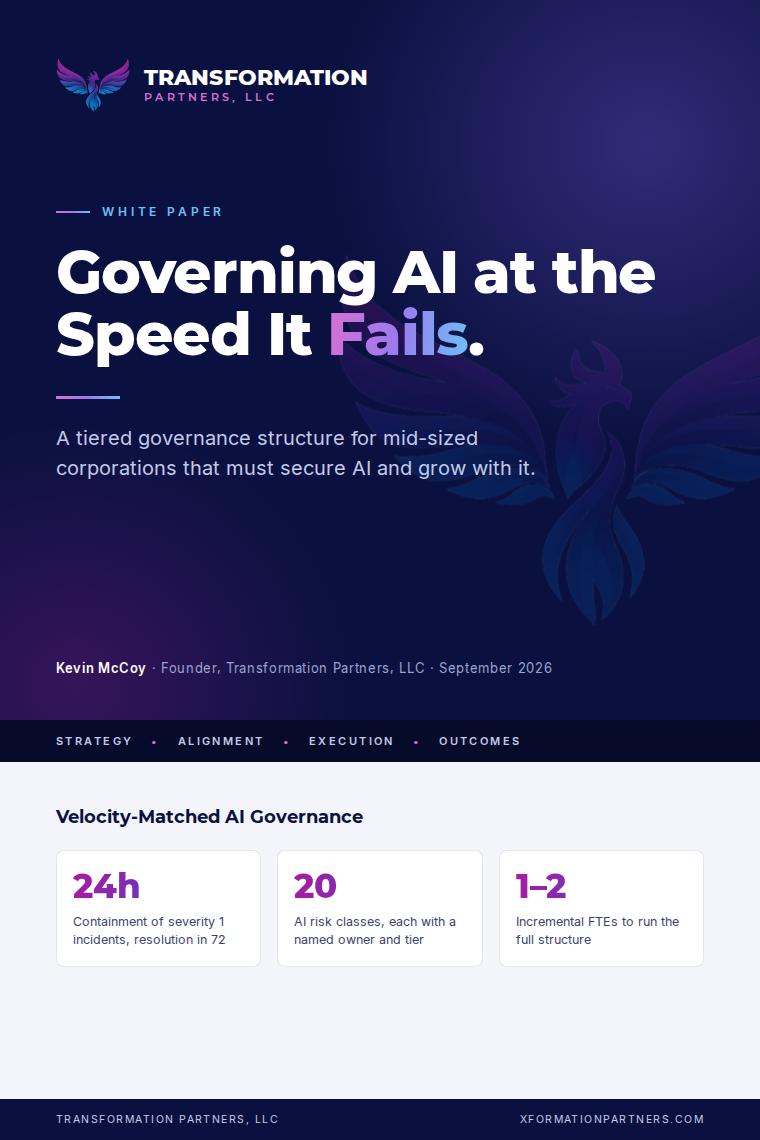
White Paper · Velocity-Matched AI Governance
A confidential document pasted into a public chatbot, a hallucinated figure sent to a regulator, or a voice-cloned executive authorizing a wire transfer each does its damage in hours. A governance committee that convenes monthly discovers such events in week three and responds in week six. For a mid-sized corporation (roughly 100 to 1,000 employees, dozens of AI systems, no dedicated AI compliance staff) that gap is where the real risk lives.
This paper presents Velocity-Matched AI Governance: a five-tier spine with two side lanes and one outer loop, organized around authority and time. Every tier, lane, and loop carries an explicit elapsed-time commitment, because failure speed determines governance cadence. The structure costs roughly one to two incremental full-time equivalents, assigns each of the twenty most likely corporate AI risks a named owner, and is built to survive its own decay.
The structure exists to make one sentence true: nothing about the company's use of AI is unowned, unwatched, or unlearned-from.
 Kevin McCoyFounder, Transformation Partners, LLC
What's Inside
Five Tiers, Five Clocks, Two Lanes, One Loop.
01 · Why Now
Ubiquity Without Visibility
AI entered the mid-sized company through hundreds of individual choices, not one gated procurement decision. Add collapsing incident timescales and real regulatory weight (the EU AI Act, a growing patchwork of U.S. state law) and the case for acting now rather than eventually is made.
02 · The Structure
Severity Lanes With Honest Clocks
Every reported issue is triaged within two hours against bright-line rules. Data confirmed outside the company, a false output delivered externally, money moving, or an active exploit is automatically severity 1: containment within 24 hours, resolution within 72, kill-switch authority pre-approved.
03 · Growth
A Value Pipeline, Not Just a Risk Pipeline
Low-risk uses need no approval at all, only conformance to a published checklist. Medium-risk uses are approved within five business days. High-risk uses go to the committee. The self-service lane widens over time, so governance says yes faster as the organization learns.
04 · Ownership
Twenty Risk Classes, Twenty Named Owners
The model was designed against a taxonomy of the twenty AI risk classes most likely to materialize inside a mid-sized corporation, each mapped to a primary owner and governing tier. Every lane handoff requires explicit acceptance so ownership is never silently dropped.
05 · Standards
Aligned to NIST AI RMF and ISO/IEC 42001
The structure operationalizes the four NIST AI RMF functions (govern, map, measure, manage) at mid-size scale and is compatible with ISO/IEC 42001, so it holds up when risk, audit, and procurement reviewers ask the questions they always ask.
06 · Candor
The Disadvantages, Catalogued Honestly
Key-person concentration, fractional roles that evaporate, the real cost of a 24-hour clock, committee gravity, and triage as a judgment bottleneck. Each is named, each has a mitigation, and each is instrumented so its failure is detected early.
Download
Get the White Paper.
Eleven pages, no fluff. Leave an email if you'd like occasional insights, or go straight to the PDF.
Or skip this and open the PDF directly. If you leave an email, we use it only to share occasional insights. No spam, ever. Want to talk about AI governance in your organization? Schedule a conversation.